Guidance and counseling relations to high school students’ positive development and psychopathology: A non-recursive modeling study

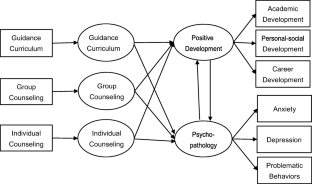
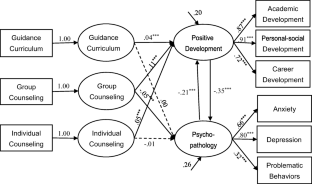
School guidance and counseling services are important for adolescent development. This study focused on the predictive role of three main delivery strategies (guidance curriculum, group counseling, and individual counseling) on students’ positive development (academic, personal-social, career) and psychopathology (anxiety, depression, problem behaviors) in the high school context. Cross-sectional data were obtained from 59 high schools and 8556 students from mainland China. The results showed that the relationships between the number of times students attended guidance and counseling services and the domains of positive development were significantly higher than the relationship of the services with psychopathology. Furthermore, non-recursive model analyses showed that the latent variable of positive development mediated the influence of the services on psychopathology. In addition, psychopathology mediated the influence of counseling on positive development. The present findings confirm that school guidance and counseling services are effective for student development in China and provide partial support for the classification of guidance and counseling delivery strategies in terms of actual service effects. While paying attention to the differences in delivery strategies, school administrators are advised to consider the indirect effects of guidance and counseling on student development, which benefits the development and integration of comprehensive guidance services.
This is a preview of subscription content, log in via an institution to check access.
Access this article
Subscribe and save
Springer+ Basic
€32.70 /Month
- Get 10 units per month
- Download Article/Chapter or eBook
- 1 Unit = 1 Article or 1 Chapter
- Cancel anytime
Buy Now
Price includes VAT (France)
Instant access to the full article PDF.
Rent this article via DeepDyve
What Adolescents Seeking Help Teach us About a School-Based Counseling Service
Article 12 May 2017
Changes in the Participants in a Community-Based Positive Youth Development Program in Hong Kong: Objective Outcome Evaluation Using a One-Group Pretest-Posttest Design
Article Open access 27 April 2018
Effects of Social Development Intervention in Childhood on Adult Life at Ages 30 to 39
Article 31 May 2019
Data Availability
The datasets generated during and/or analysed during the current study are not publicly available due ethical considerations but are available from the corresponding author on reasonable request.
References
- Andresen, E. M., Malmgren, J. A., Carter, W. B., & Patrick, D. L. (1994). Screening for depression in well older adults: Evaluation of a short form of the CES-D. American Journal of Preventive Medicine, 10(2), 77–84. https://doi.org/10.1016/s0749-3797(18)30622-6. ArticlePubMedGoogle Scholar
- ASCA (2012). The ASCA national model: A framework for school counseling programs (PsycEXTRA Dataset). American Psychological Association (APA).
- ASCA (2016). State-by-state student-to-counselor ratio report 10-year trends. https://www.nacacnet.org/globalassets/documents/publications/research/state-by-state-ratio-report.pdf.
- Brennan, R. L. (2001). Generalizability theory. Springer-Verlag.
- Briesch DuBois, J. M., Briesch, A. M., Hoffman, J. A., Struzziero, J., & Toback, R. (2017). Implementing self-management within a group counseling context: Effects on academic enabling behaviors. Psychology in the Schools, 54(8), 852–867. https://doi.org/10.1002/pits.22029. ArticleGoogle Scholar
- Burlingame, G. M., McClendon, D. T., & Alonso, J. (2011). Cohesion in group therapy. Psychotherapy, 48(1), 34–42. https://doi.org/10.1037/a0022063. ArticlePubMedGoogle Scholar
- Carey, J., & Dimmitt, C. (2012). School counseling and student outcomes: Summary of six statewide studies. Professional School Counseling. https://doi.org/10.1177/2156759X0001600204.
- Chaves, C., Lopez-Gomez, I., Hervas, G., & Vazquez, C. (2016). A comparative study on the efficacy of a positive psychology intervention and a cognitive behavioral therapy for clinical depression. Cognitive Therapy and Research, 41(3), 417–433. https://doi.org/10.1007/s10608-016-9778-9. ArticleGoogle Scholar
- Colman, A. M. (2015). Oxford dictionary of psychology. In A. M. Colman (Ed.), Oxford dictionary of psychology. Oxford University Press.
- Daunic, A. P., Smith, S. W., Aydin, B., & Barber, B. (2019). Lowering Risk for Significant Behavior Problems Through Cognitive-Behavioral Intervention: Effects of the Tools for Getting Along Curriculum 2 Years Following Implementation. Journal of Primary Prevention,40(4), 463–482. https://doi.org/10.1007/s10935-019-00554-3. ArticlePubMedGoogle Scholar
- Daunic, A. P., Smith, S. W., Garvan, C. W., Barber, B. R., Becker, M. K., Peters, C. D., Taylor, G. G., van Loan, C. L., Li, W., & Naranjo, A. H. (2012). Reducing developmental risk for emotional/behavioral problems: A randomized controlled trial examining the tools for getting along curriculum. Journal of School Psychology, 50(2), 149–166. https://doi.org/10.1016/j.jsp.2011.09.003. ArticlePubMedGoogle Scholar
- Diedenhofen, B., & Musch, J. (2015). Cocor: A comprehensive solution for the statistical comparison of correlations. PLoS ONE, 10(4), e0121945. https://doi.org/10.1371/journal.pone.0121945. ArticlePubMedPubMed CentralGoogle Scholar
- Doll, B. (2008). The dual-factor model of mental health in youth. School Psychology Review, 37(1), 69–73. https://doi.org/10.1080/02796015.2008.12087909. ArticleGoogle Scholar
- D'raven, L. L., & Pasha-Zaidi, N. (2014). Positive psychology interventions: A review for counseling practitioners. Canadian Journal of Counseling and Psychotherapy, 48(4), 383–408. Google Scholar
- Durlak, J. A., & Wells, A. M. (1997). Primary prevention mental health programs for children and adolescents: A meta-analytic review. American Journal of Community Psychology, 25(2), 115–152. https://doi.org/10.1023/a:1024654026646. ArticlePubMedGoogle Scholar
- Eichas, K., Albrecht, R. E., Garcia, A. J., Ritchie, R. A., Varela, A., Garcia, A., Rinaldi, R., Wang, R., Montgomery, M. J., Silverman, W. K., Jaccard, J., & Kurtines, W. M. (2010). Mediators of positive youth development intervention change: Promoting change in positive and problem outcomes? Child & Youth Care Forum, 39(4), 211–237. https://doi.org/10.1007/s10566-010-9103-9. ArticleGoogle Scholar
- Fang, X., Hu, W., Chen, H., & Wang, F. (2015). Developmental guidance for high school students in China: Status quo and effectiveness. Journal of Beijing Normal University, 247(1), 47–54.
- Fatih, Y., Kadir, O., & Canan, E. (2020). Investigation of the relationship between disease severity and automatic thought and dysfunctional schemes in patients with depression and non-clinical group: A structural equation modeling study. Current Psychology, 9, 1635–1650. https://doi.org/10.1007/s12144-018-0064-8. ArticleGoogle Scholar
- Fenwick, L. (2018). Standards-based reform to senior-secondary curriculum and metacognition in the literacy domain. Curriculum Journal, 29(3), 338–353. https://doi.org/10.1080/09585176.2018.1424643. ArticleGoogle Scholar
- Gysbers, N. C. (2004). Comprehensive guidance and counseling programs: The evolution of accountability. Professional School Counseling, 8, 1–14. Google Scholar
- Gysbers, N. C. (2005). Comprehensive school guidance programs in the United States: A career profile. International Journal for Educational and Vocational Guidance, 5(2), 203–215. https://doi.org/10.1007/s10775-005-8800-7. ArticleGoogle Scholar
- Gysbers, N. C., & Henderson, P. (2012). Developing & managing your School Guidance & Counseling Program (5th). American Association for Counseling and Developments.
- Hu, W., Fang, X., Chen, H., Deng, L., & Lin, X. (2015). The relationship between three-domain competences and internalizing and externalizing problems in Chinese high school students. Child Indicators Research, 8(4), 943–959. https://doi.org/10.1007/s12187-014-9290-2. ArticleGoogle Scholar
- Hui, E. K. P. (1999). Building an effective guidance Service in Hong Kong: A qualitative study. Asia Pacific Journal of Education, 19(1), 78–88. https://doi.org/10.1080/0218879990190107. ArticleGoogle Scholar
- Hui, E. K. P. (2000). Guidance as a whole school approach in Hong Kong: From remediation to student developments. International Journal for the Advancement of Counselling, 22(1), 69–82. https://doi.org/10.1023/a:1005494502922. ArticleGoogle Scholar
- Kamm, C., Gebhardt, A., Gonon, P., Bruehwiler, C., & Dernbach-Stolz, S. (2020). Learners' perceptions of a career guidance curriculum in different school-based support systems in Switzerland. Journal of Vocational Education and Training, 72(3), 375–395. https://doi.org/10.1080/13636820.2019.1610474.
- Khalilzadeh, S., & Khodi, A. (2018). Teachers’ personality traits and students’ motivation: A structural equation modeling analysis. Current Psychology, 12, 1635–1650. https://doi.org/10.1007/s12144-018-0064-8. ArticleGoogle Scholar
- Lapan, R. T., Gysbers, N. C., & Sun, Y. (1997). The impact of more fully implemented guidance programs on the school experiences of high school students: A statewide evaluation study. Journal of Counseling & Development, 75(4), 292–302. https://doi.org/10.1002/j.1556-6676.1997.tb02344.x. ArticleGoogle Scholar
- Lerner, R. M. (2006). Theoretical models of human developments (Vol. 1): Handbook of child psychology (6th ed). Wiley.
- Lerner, R. M., Lerner, J. V., & Benson, J. B. (2011). Positive youth development. Positive Youth Development (pp. 1-17): Elsevier.
- Ministry of Education of the People’s Republic of China. (2017). School management standards for compulsory education.
- O’Connor, M., Sanson, A., Hawkins, M. T., Toumbourou, J. W., Letcher, P., & Frydenberg, E. (2011). Differentiating three conceptualisations of the relationship between positive development and psychopathology during the transition to adulthood. Journal of Adolescence, 34(3), 475–484. https://doi.org/10.1016/j.adolescence.2010.06.005. ArticlePubMedGoogle Scholar
- Pinquart, M. (2017). Associations of parenting dimensions and styles with externalizing problems of children and adolescents: An updated meta-analysis. Developmental Psychology, 53(5), 873–932. https://doi.org/10.1037/dev0000295. ArticlePubMedGoogle Scholar
- Podsakoff, P. M., MacKenzie, S. B., & Podsakoff, N. P. (2012). Sources of method Bias in social science research and recommendations on how to control it. Annual Review of Psychology, 63(1), 539–569. https://doi.org/10.1146/annurev-psych-120710-100452. ArticlePubMedGoogle Scholar
- Schwartz, S. J., Pantin, H., Coatsworth, J. D., & Szapocznik, J. (2007). Addressing the challenges and opportunities for Today's youth: Toward an integrative model and its implications for research and intervention. The Journal of Primary Prevention, 28(2), 117–144. https://doi.org/10.1007/s10935-007-0084-x. ArticlePubMedGoogle Scholar
- Seiffge-Krenke, I., & Gelhaar, T. (2008). Does successful attainment of developmental tasks lead to happiness and success in later developmental tasks? A test of Havighurst's (1948) theses. Journal of Adolescence, 31(1), 33–52. https://doi.org/10.1016/j.adolescence.2007.04.002. ArticlePubMedGoogle Scholar
- Sloane, D. M., & Potvin, R. H. (1986). Religion and delinquency: Cutting through the maze. Social Forces, 65(1), 87–105. https://doi.org/10.1093/sf/65.1.87. ArticleGoogle Scholar
- Wang, C., Ni, H., Ding, Y., & Yi, C. (2014). Chinese teachers’ perceptions of the roles and functions of school psychological service providers in Beijing. School Psychology International, 36(1), 77–93. https://doi.org/10.1177/0143034314560623. ArticleGoogle Scholar
- Wang, X. D., Wang, X. L., & Ma, H. (1999). Rating scales for mental health (enlarged edition). Chinese Mental Health Journal.
- Whiston, S. C., Brecheisen, B. K., & Stephens, J. (2003). Does treatment modality affect career counseling effectiveness? Journal of Vocational Behavior, 62(3), 390–410. https://doi.org/10.1016/s0001-8791(02)00050-7. ArticleGoogle Scholar
- Whiston, S. C., Tai, W. L., Rahardja, D., & Eder, K. (2011). School counseling outcome: A meta-analytic examination of interventions. Journal of Counseling & Development, 89(1), 37–55. https://doi.org/10.1002/j.1556-6678.2011.tb00059.x. ArticleGoogle Scholar
- Wood, J. (2006). Effect of anxiety reduction on children’s school performance and social adjustment. Developmental Psychology, 42(2), 345–349. https://doi.org/10.1037/0012-1649.42.2.345. ArticlePubMedGoogle Scholar
- Xu, J., Fang, X., Zhang, J., Lin, D., & Sun, L. (2008). Effect mechanism of family functioning on adolescents emotional problem [in Chinese]. Psychological Developments and Education, 2, 79–85. https://doi.org/10.16187/j.cnki.issn1001-4918.2008.02.0. ArticleGoogle Scholar
- Yuen, M., Gysbers, N. C., Hui, E. K. P., Leung, K. M., Lau, P. S. Y., Chan, R. M. C., Shea, P. M. K., & Ke, S. S. Y. (2004). University of Hong Kong faculty of education life skills development project. University of Hong Kong.
- Zhang, W., Hu, X., & Pope, M. (2002). The evolution of career guidance and counseling in the People's Republic of China. The Career Development Quarterly, 50(3), 226–236. https://doi.org/10.1002/j.2161-0045.2002.tb00898.x. ArticleGoogle Scholar
- Zung, W. W. K. (1971). A rating instrument for anxiety disorders. Psychosomatics, 12(6), 371–379. https://doi.org/10.1016/s0033-3182(71)71479-0. ArticlePubMedGoogle Scholar
